iReject vs Mend: a private no-contact app for the hardest moments
Mend helps you understand heartbreak through guided audio. iReject is for the moment your thumb is hovering over their name. Here's how they compare.
The short answer
Choose Mend if you want to learn and listen: a large library of guided audio trainings and a community of people going through the same thing. Choose iReject if you need help staying no contact day to day: a counter, an SOS to open instead of texting your ex, a private journal, and no account.
Why people look for a Mend alternative
Mend is one of the best-known names in breakup recovery. It began as an app built around short daily audio trainings, and today its signature program offers hundreds of audio trainings, journal prompts, a 60-day ex detox module and a members' community. If you want to understand why heartbreak hurts the way it does, that's a lot of good material.
But the hardest part of a breakup often isn't a lack of understanding. It's 1am, you've had a bad day, and you're about to send "hey, how are you?" In that moment, a course isn't what stops you. People looking for an alternative usually want:
- Something for the urge itself. A thing to open instead of the chat.
- A visible no-contact count. A number that makes the cost of breaking it feel real.
- Privacy. No sign-up, no community, and a journal that never leaves the phone.
- Something light. Two minutes a day, not another course to keep up with.
iReject vs Mend at a glance
| Feature | iReject | Mend |
|---|---|---|
| Approach | A private tool for daily recovery and urges | A guided course with audio, prompts and community |
| No-contact tracking | Live counter with 7, 30, 60 and 90-day milestones | A 60-day ex detox module |
| In-the-moment help | SOS, your own reasons, breathing exercises, AI listener | Audio trainings to return to |
| Journal | Private, on your device, passcode lock | Journal prompts |
| Expert audio library | No | Hundreds of audio trainings |
| Community | No, private by design | Members' community |
| Account | Not needed | Sign-up to access the program |
| Price | Free with optional in-app purchases, no ads | Paid program |
What iReject does differently
A counter that makes no contact visible
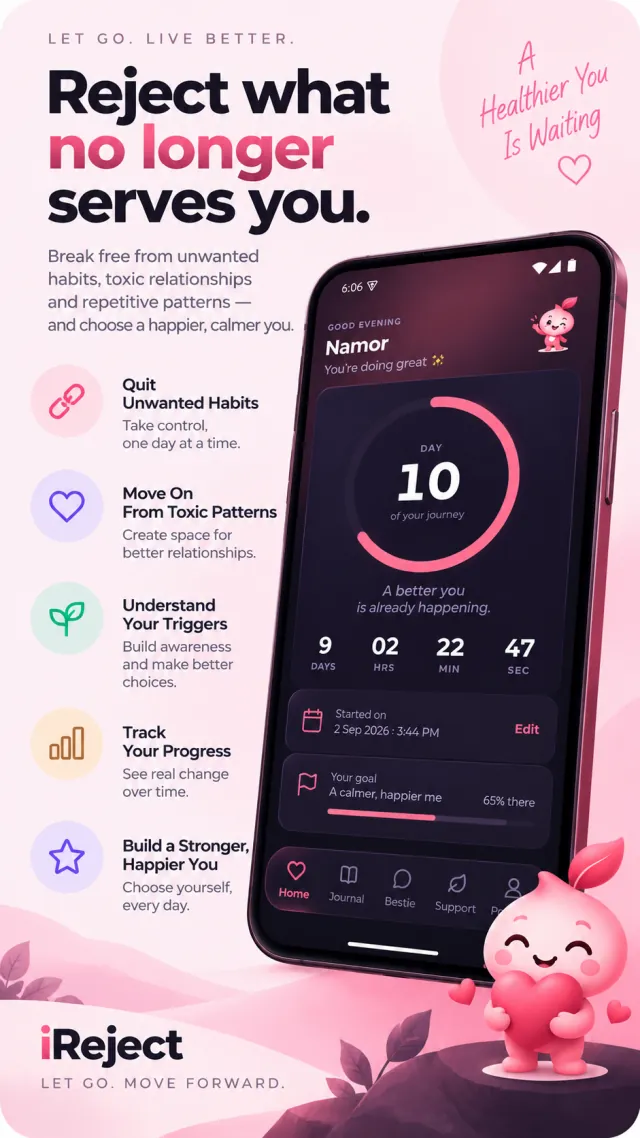
iReject's home screen shows how long you've gone without contact, down to the minute, with milestones at 7, 30, 60 and 90 days. You can set the date it started, so the count reflects your real progress from day one. It's there to keep momentum visible, not to turn healing into a performance.
An SOS for when you want to text them
When the urge hits, open iReject first. The SOS puts your own reasons for leaving in front of you, in your own words, at exactly the moment you're romanticising the past. If you need to say something, write it as an unsent message and keep it private, instead of sending it in the middle of a spiral. And if you need to talk it through, the AI listener gives a reflective, non-judgmental response.
Tools to calm your body first
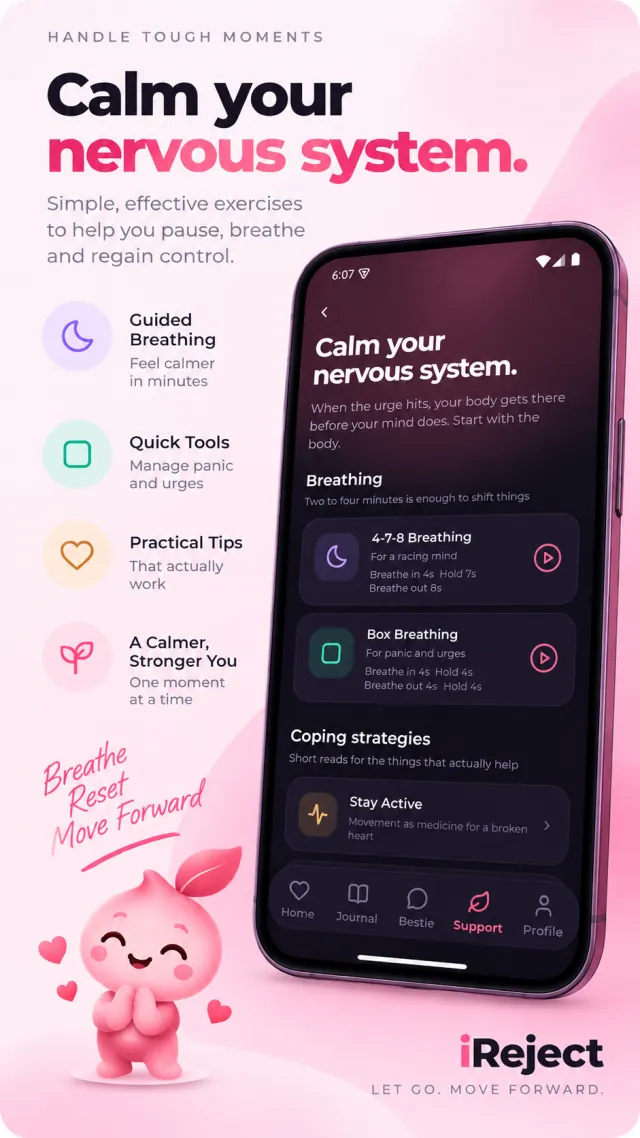
Urges are physical as much as mental. The Support tab has guided breathing exercises such as 4-7-8 and box breathing, plus short, practical coping strategies for panic and urges.
Remember why you left
After a breakup, memory edits itself into something kinder than it was. iReject gives you a place to write down why the relationship wasn't right, whether it was toxic, a situationship or simply the wrong person. The anchors wall keeps screenshots and notes of what really happened, archived rather than deleted, so you can check the facts without reliving them.
A journal, a journey and your progress
The private journal includes prompts for days you don't know where to start. A 10-week guided journey adds small tasks and milestones. You can log moods, slip-ups and wins, see how you're doing over time, and set gentle daily reminders.
Private by design
No account is needed. Your journal stays on your device, and you can lock the app with a passcode. iReject has no ads.
When Mend is the better choice
- You want to understand what you're going through. Mend's library of guided audio goes much deeper into the psychology of heartbreak than iReject does.
- You'd rather listen than write. If journaling isn't for you, a daily audio session may suit you better.
- You want company. Mend's community connects you with people who get it. iReject is deliberately private.
They also work well together: Mend to learn and process, iReject in your pocket for the moments in between.
Neither app is therapy. If you're struggling to cope, or having thoughts of harming yourself, please reach out to a mental health professional or a local crisis line right away.
How to start with iReject
- Install iReject from Google Play. There's no sign-up.
- Set the date your no contact started.
- Write at least three reasons it wasn't right. These are what you'll read in the SOS.
- Set a passcode and a daily reminder.
- Next time you feel the urge, open iReject before you open their chat.
Disclosure: iReject is made by MYX, the publisher of this article. Mend is a trademark of its respective owner, and MYX is not affiliated with or endorsed by Mend. Details about Mend were checked in October 2026 and may have changed since, so check Mend's website for its current program and pricing.
iReject vs Mend: questions
They do different jobs. Mend is a guided course for understanding and healing from heartbreak. iReject is a private tool for daily recovery, especially the moments you want to break no contact. Some people use both.
No. You can use iReject without an account.
Yes. Your journal stays on your device, and you can lock the app with a passcode.
Log it as a slip-up, reread your reasons, and start again. iReject tracks slip-ups alongside wins because recovery is rarely a straight line.
iReject is free to download with optional in-app purchases, and it has no ads.
No. iReject is a self-help tool, not therapy or medical care. If you're struggling to cope, please reach out to a mental health professional or a local crisis line.